If you already have solar panels on your home, or you are considering installing a solar and battery system, you may have seen some fairly confusing headlines recently about Eskom, registration deadlines, fines and possible disconnections.
The good news is that the situation has become a little clearer.
The less-good news is that there is still an ongoing disagreement about exactly how residential solar installations should be regulated.
So, rather than adding another layer of technical jargon, here is what Gauteng homeowners actually need to know.

What is happening with Eskom and residential solar?
Eskom’s current position is that households and small businesses with grid-connected Small-Scale Embedded Generation (SSEG) systems below 100kVA must register their systems with the relevant electricity distributor.
For an Eskom-direct customer, that means Eskom.
If your electricity is supplied by a municipality or municipal electricity distributor, such as City Power or another local authority, you need to follow the requirements of that electricity provider instead.
Eskom states that registration applies even where your solar system has been configured not to feed excess electricity back into the grid. Fully off-grid systems that operate independently from Eskom’s network are treated differently.
Why is everyone talking about 30 September 2026?
Eskom has extended its residential solar registration and connection cost waiver until 30 September 2026 for qualifying systems of up to 50kVA.
According to Eskom, this waiver can cover registration and connection-related charges as well as a smart meter where required. Eskom has indicated that the benefit can be worth up to approximately R10,000 for urban residential customers.
In practical terms, homeowners who need to register an eligible system currently have an opportunity to do so without the normal registration-related costs applying.
Eskom officially confirmed this extension on 26 March 2026.
Recent reporting following discussions between Eskom and OUTA also describes 30 September 2026 as the current registration deadline for affected residential solar and battery systems.

Has Eskom changed its position?
Yes… and this is an important part of the latest news.
According to reports published by Moneyweb and Daily Maverick in September 2026, Eskom has softened several aspects of its earlier approach following discussions with OUTA and other stakeholders.
Most importantly, Eskom no longer requires an ordinary residential solar installation to be signed off specifically by an ECSA-registered engineering professional.
Eskom’s own current guidance says that the relevant installation test report can be completed by an appropriately registered Department of Employment and Labour installation electrician or master installation electrician, subject to the applicable requirements.
Moneyweb and Daily Maverick also report that Eskom has withdrawn earlier threats to automatically fine or disconnect residential customers simply for failing to register their systems.
However, Eskom maintains that it may act where a solar or battery installation is considered unsafe.
That particular issue remains disputed by OUTA.
So, does my solar system still need to be compliant?
Absolutely.
And this is perhaps the most important point for homeowners.
The argument currently taking place between Eskom, OUTA and other stakeholders is largely around registration, regulatory authourity and administrative requirements.
It should not be confused with electrical safety.
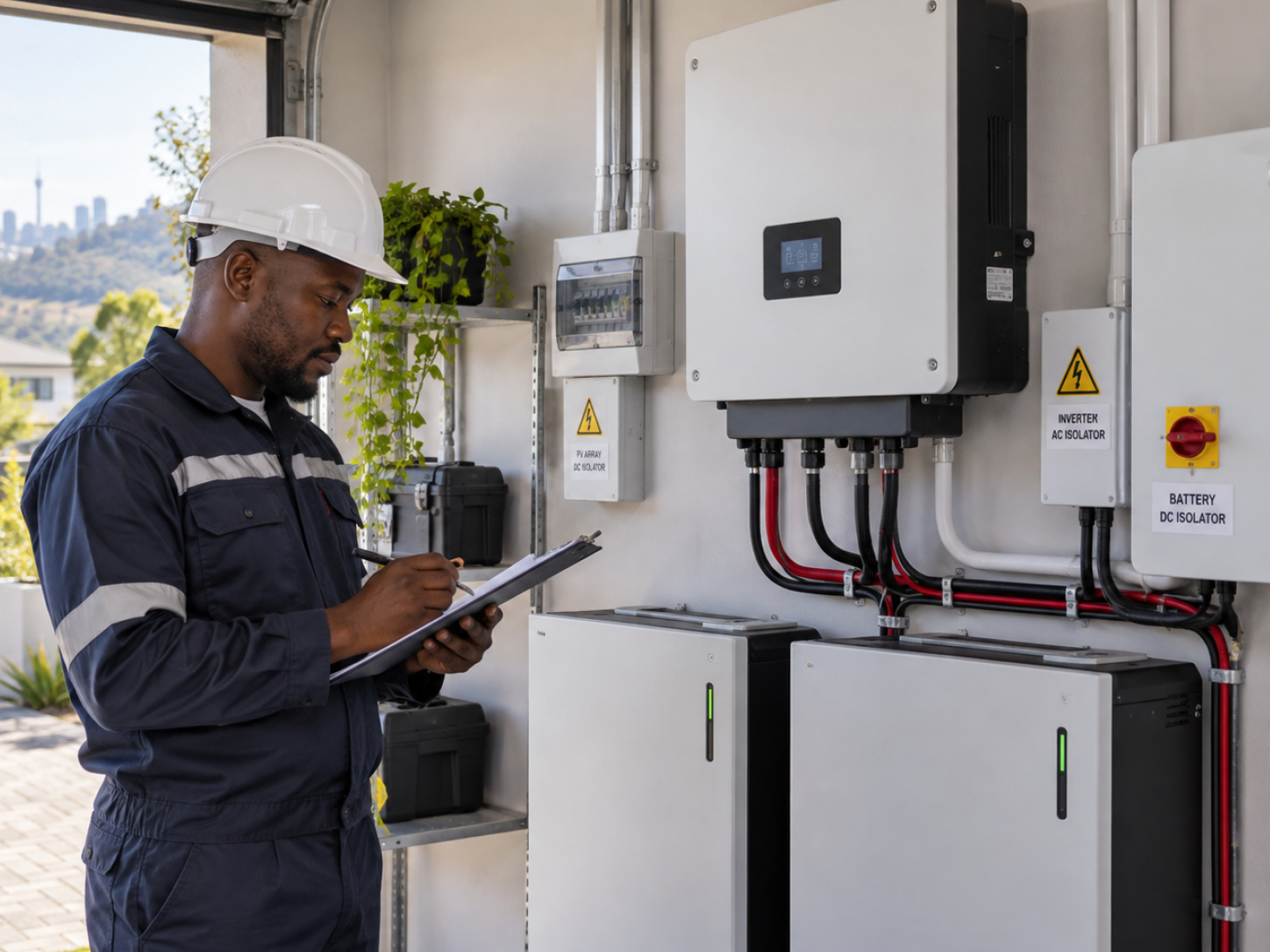
A solar installation involves high-voltage DC electricity, batteries, an inverter and a connection into your home’s electrical distribution system. Poor workmanship, incorrect protection equipment or badly configured equipment can create genuine fire, electrical and grid-safety risks.
Eskom specifically highlights the risk of incorrectly installed grid-connected systems back-feeding electricity onto the network, potentially endangering technicians and affecting electricity quality.
A homeowner should therefore be able to establish that their solar installation was completed properly and that the necessary electrical compliance documentation exists.
What documentation does Eskom currently ask for?
For qualifying residential installations, Eskom has simplified the documentation considerably.
Its current published requirements include:
- A valid electrical Certificate of Compliance (CoC) issued by an appropriately registered person.
- The inverter’s NRS 097-2-1 type-test certificate, normally supplied by the inverter or equipment supplier.
- An Embedded Generation Installation test report completed by an appropriately qualified and registered person.
Eskom says an ECSA-registered professional is no longer mandatory for the normal residential process.
If you’ve had solar installed and none of those documents sound familiar, it would be sensible to have the installation checked.

But OUTA says something different. Who is right?
This is where the issue becomes more complicated.
OUTA’s position is that a residential solar installation that has been safely installed by a suitably qualified electrical contractor and has a valid Certificate of Compliance should not require another layer of registration simply to prove electrical safety.
OUTA argues that the legal authority to regulate electrical installation safety rests with the relevant structures under the Department of Employment and Labour rather than Eskom itself.
It has therefore challenged aspects of Eskom’s registration approach and similar municipal processes.
That dispute has not made electrical compliance optional.
If anything, it makes having proper documentation even more important.
The sensible position for a homeowner is not to get caught between Eskom and OUTA’s lawyers. Make sure your installation is safe, correctly installed and properly documented.
Then determine the registration requirements that apply to your particular electricity supplier.
First establish who actually supplies your electricity
This is particularly important in Gauteng.
Not every Johannesburg, Pretoria, Ekurhuleni, Midrand, Sandton or surrounding homeowner is supplied directly by Eskom.
Some homes receive electricity directly from Eskom, while others receive electricity through municipalities or municipal distributors.
The registration procedure that applies to you therefore depends on who sends you your electricity bill or supplies your prepaid electricity.
Eskom itself advises customers purchasing electricity from municipalities to approach their municipality regarding the applicable requirements.
For example, City Power has introduced its own solar approval procedures in Johannesburg. Those requirements have also attracted criticism from OUTA, demonstrating why homeowners should not assume that Eskom’s process automatically applies everywhere in Gauteng.
What if my installer disappeared or I don’t have the paperwork?
This is something we expect many homeowners will discover.
During the height of load shedding, thousands of South Africans installed solar systems quickly. Some installations were completed professionally. Others were sold as packages by businesses that have since disappeared, changed names or simply stopped answering the phone.
You may have an excellent solar system but be unsure whether the paperwork is correct.
Or you may have a CoC but aren’t sure whether it covers the solar installation.
You might also have bought a home where the previous owner installed the solar system.
Don’t panic.
The first step is simply to establish what equipment is installed, what documentation exists and whether the installation meets the appropriate electrical and grid-connection requirements.
Any problems can then be dealt with properly rather than guessed at.
Installing new solar? Compliance should be part of the job
When comparing solar quotations, homeowners understandably concentrate on panels, battery capacity, inverter size and price.
Compliance should be discussed at the same time.
A very cheap installation becomes rather expensive if someone else needs to repair, rewire or certify it afterwards.
At Gauteng House & Garden, our approach is to ensure solar projects are carried out using appropriately skilled professionals and with the required electrical compliance and supporting documentation considered as part of the project.
It is not simply about getting panels onto a roof and an inverter onto a wall.
The installation needs to be safe, properly completed and suitable for the property it is serving.
Already have solar and unsure whether you’re compliant?
If you already have a solar or battery system and you’re unsure whether your installation is compliant, whether you have the correct CoC, or what documentation you should have received from your installer, Gauteng House & Garden can assist.
We can help assess the installation, identify missing compliance documentation and coordinate the appropriate qualified solar and electrical specialists where necessary.
We can also help you understand whether you are supplied directly by Eskom or need to deal with your local electricity distributor.
Rather check now than discover a problem when you’re selling your home, making an insurance claim or dealing with your electricity provider.
Need help with your solar installation?
Whether you’re planning a new solar installation or you already have a system and want peace of mind that everything has been done correctly, speak to Gauteng House & Garden.
One Project Partner. The Right Specialist for Every Trade.
Contact us to arrange a solar installation assessment or discuss your requirements.