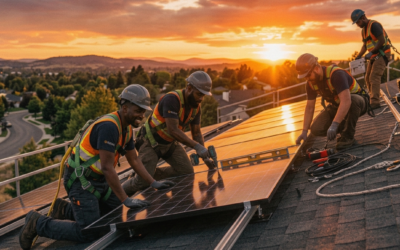
You do not necessarily need R100,000 in cash to install solar
Many Gauteng homeowners and business owners want solar for two important reasons:
-
-
- To reduce rising electricity costs.
- To keep essential equipment running during power failures.
-
The obstacle is usually the upfront price. A properly designed solar system can cost anywhere from approximately R45,000 for essential backup to more than R250,000 for a larger hybrid system.
Fortunately, several South African banks offer ways to finance solar installations. With the right system and finance structure, the electricity savings can help offset the monthly loan repayment.
The important word is “help”. Solar should never be sold with a vague promise that it will automatically pay for itself from the first month. The figures must be calculated using your actual electricity consumption, the proposed system’s expected production and the full cost of the finance.
Gauteng House & Garden can help you assess your needs, design an appropriate system and provide a detailed quotation for submission to your bank.
First understand what you are financing
Not every backup power system reduces your electricity bill.
Backup inverter and battery
This keeps selected appliances running during an outage. Because the battery is normally charged from the grid, it may provide power security without producing significant electricity savings.
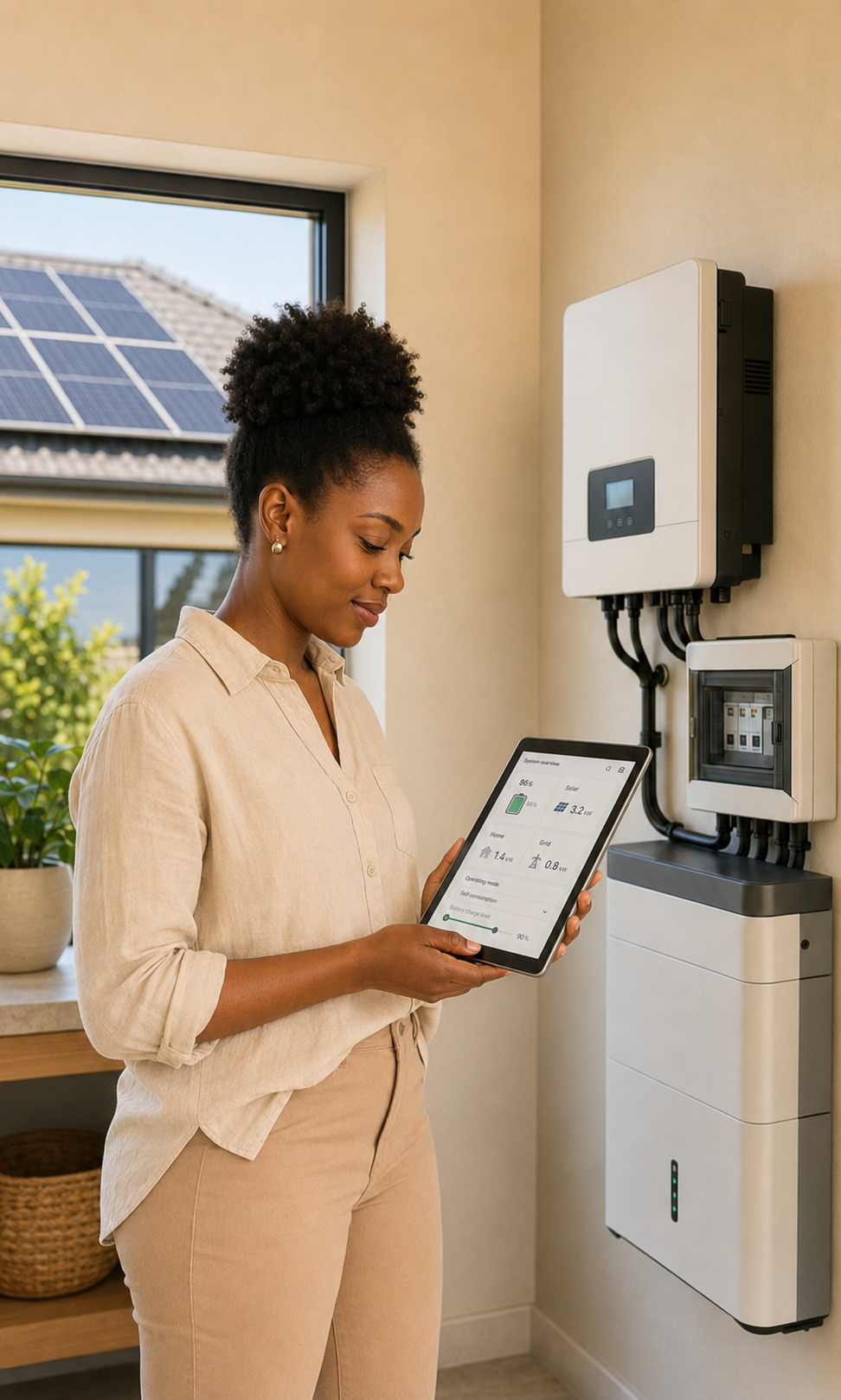
Solar panels, inverter and battery
This is a hybrid solar system. The panels generate electricity during the day, the inverter manages the energy and the battery stores power for later use.
If reducing your electricity bill is the main goal, your system needs enough solar-panel capacity—not only a battery.
Grid-tied solar without batteries
This can reduce daytime electricity costs, particularly for businesses, but generally does not provide backup power when the grid fails. A grid-tied inverter normally switches off during an outage for safety.
We help you choose the correct balance between savings, backup capacity and affordability.
Solar-finance options currently available in South Africa
Bank products and lending criteria change regularly. The following options were available as at 21 July 2026 and remain subject to credit approval, affordability assessments and the lender’s terms.
| Provider | Current solar-finance options | Important considerations |
|---|---|---|
| Absa | Existing Absa home-loan customers can apply for a Further Advance or ReAdvance of between R50,000 and R300,000, structured over up to seven years. | A Further Advance can attract bond-registration costs, while a ReAdvance uses funds already repaid against the original bond. View Absa Solar and Energy Finance |
| FNB | A solar-energy loan can be added to a new home loan, switch, readvance, further loan or future-use application. | A property valuation, credit assessment or additional bond may be required. The system must be purchased from a provider that meets FNB’s accreditation requirements. View the FNB alternative-energy guide |
| Nedbank | Options include a new home-loan add-on, NedRevolve funds, a readvance, further loan or standalone MFC asset finance over up to 96 months. The MFC option does not require a Nedbank home loan. | Certain products require an approved or appropriately accredited supplier. Nedbank also advertises small-business solar finance of up to R3.5 million. View Nedbank solar finance |
| Standard Bank | Business Solar Financing is offered from R10,000 through a Business Term Loan, with repayment over up to 60 months. | The rate is personalised and prime-linked. New business clients generally need at least two years’ trading history. Fees and credit checks apply. View Standard Bank Business Solar Financing |
| Absa Business | Green Asset Finance generally runs over five to seven years, while its Renewable Energy Term Loan may run for up to ten years. | Absa states that financing of up to 100% may be available without additional security, depending on the applicant’s risk profile. View Absa business solar finance |
Other possibilities include personal loans, business asset finance and solar subscription or rent-to-own agreements.
These can be useful when you do not have a home loan, but compare the interest, annual increases, ownership conditions, early-settlement rules and total repayment carefully.
The easiest step-by-step solar-finance process
Step 1: Gather your electricity information
Before requesting a system, collect:
- Your latest three to six electricity bills.
- Your property address.
- A list of the appliances or equipment you need during an outage.
- Your preferred monthly budget.
- Details of generator or diesel expenses, if applicable.
- Your operating hours if the system is for a business.
Electricity usage matters more than the size of the building. Two similar homes can require completely different systems.
Step 2: Decide what you want solar to achieve
Choose your main priority:
- Essential backup during outages.
- Lower monthly electricity bills.
- Both backup power and meaningful savings.
- Near-total independence from the grid.
This prevents you from borrowing too much for an oversized system—or too little for a system that disappoints you.
Step 3: Arrange a solar assessment
Gauteng House & Garden and our certified affiliated installation partner will assess:
- Your electricity consumption.
- The condition and capacity of your DB board.
- Roof space, condition, angle and shading.
- Suitable inverter and battery positions.
- Safe and neat cable routes.
- Your electricity supplier and registration requirements.
- Future expansion possibilities.
Where possible, we design systems that can be expanded later. Starting with a properly planned, upgradeable system can be more affordable than financing everything at once.
Step 4: Receive a finance-ready quotation
Your quotation should clearly show:
- Inverter brand, model and capacity.
- Battery brand and storage capacity.
- Number and wattage of solar panels.
- Mounting, cabling and electrical protection.
- Labour, testing and commissioning.
- Certificate of Compliance.
- Warranty information.
- Registration assistance where applicable.
- The total installed price and payment terms.
Some banks only finance systems supplied by approved or accredited providers. We will help provide the installer and system documents required, but final supplier acceptance remains the bank’s decision.
Step 5: Compare the correct finance routes
Start with these options in order:
- Existing home-loan readvance or further lending, which may offer a better interest rate.
- Standalone solar asset finance, especially if you do not have a bond.
- Business green asset or term finance.
- A smaller deposit combined with a smaller loan.
- Personal finance, after carefully comparing its higher total cost.
- A staged installation if the full system is not currently affordable.
A home-loan extension can reduce the monthly repayment, but stretching a solar purchase over 20 years can create a surprisingly large interest bill. If possible, place additional money into the loan and aim to settle the solar portion over a shorter period.
Step 6: Test whether the numbers genuinely work
Use this simple calculation:
Estimated monthly benefit = electricity saving + avoided generator costs + measurable downtime savings
Then calculate:
Net monthly cost = finance repayment − estimated monthly benefit
For example, if the finance repayment is R2,300 and the system is expected to save R1,600, the household is still paying approximately R700 extra per month during the loan term. That may still be worthwhile for backup power and long-term ownership, but the system is not “free”.
Ask for a conservative annual energy-production estimate. Fixed municipal charges may remain even after your electricity consumption drops.
Step 7: Submit your application directly to the bank
A homeowner will typically need:
- South African ID.
- Proof of address.
- Recent payslips or proof of income.
- Bank statements.
- Solar quotation.
- Property and home-loan information.
- Body-corporate approval for sectional-title properties, where required.
A business may also need:
- Company registration documents.
- Financial statements or management accounts.
- Business bank statements.
- Electricity bills.
- Tax and director information.
- Supplier quotation and expected savings.
- Details of the property owner or lease agreement.
Do not pay a large, non-refundable deposit until the bank has approved the finance and confirmed how the supplier will be paid.
Step 8: Installation, testing and handover
Once finance is approved, we arrange the installation and keep you informed throughout the project.
Our focus is not only on whether the system works. We also plan the equipment positioning, cable routes, labelling, safety protection and finishing so the completed installation looks professional and remains easy to maintain.
After commissioning, you should receive the applicable:
- Electrical Certificate of Compliance.
- Equipment warranties.
- Inverter test certificate.
- System settings and operating guidance.
- Installation test report.
- Registration documents or assistance.
- Monitoring-app access.
Solar registration in Gauteng
Grid-connected solar systems must be registered with the electricity supplier serving the property. This may be Eskom, City Power, the City of Tshwane, Ekurhuleni or another local municipality.
A CoC confirms electrical compliance, but it does not replace SSEG registration.
For Eskom-supplied properties, Eskom has extended its registration and connection fee waiver for qualifying systems up to 50kVA until 30 September 2026. The waiver can include a smart meter where required. Municipal processes and charges may differ. Read Eskom’s current SSEG announcement.
Our team will help identify the correct process for your property. You can also read our guide to certified solar installation, CoCs and registration requirements in Gauteng.
Benefits and risks of financing solar
Benefits
- You do not need the full purchase price upfront.
- Solar panels can reduce grid-electricity consumption.
- Battery storage protects essential equipment during outages.
- Businesses can reduce generator use and operational interruptions.
- The system becomes a long-term asset once it is paid off.
- A properly documented installation may improve the appeal of the property.
Risks and costs
- Interest and fees increase the total system cost.
- A variable interest rate can increase the repayment.
- Weather, shading and usage habits affect actual savings.
- Batteries may eventually need replacement.
- Secured finance places the debt against your property.
- Poor workmanship can affect warranties, safety and insurance.
- Some bank products restrict which installers or equipment may be used.
Add the system to your building or business insurance immediately after installation. Confirm cover for panels, batteries, inverters, theft, fire, lightning and storm damage.
What about solar tax incentives?
The temporary residential solar-panel rebate applied to qualifying systems brought into use during the 2024 tax period; it should not be included when calculating a new installation in 2026.
Businesses may still qualify for certain renewable-energy capital allowances under section 12B, depending on ownership, trade use and other requirements. Obtain advice from a registered tax practitioner before treating a tax deduction as part of the project’s return.
Get a free solar assessment and finance-ready quote
You do not need to understand every inverter, battery, loan product and registration form before taking the first step. That is where we help.
Gauteng House & Garden provides residential and commercial solar solutions throughout Johannesburg, Pretoria, Centurion, Midrand, Sandton, Randburg, the East Rand, West Rand, Vaal and surrounding Gauteng areas.
We will help you:
- Understand your electricity consumption.
- Choose the correct system for your needs.
- Keep the installation within a realistic budget.
- Receive a detailed quotation for your finance application.
- Install a safe, compliant and professionally finished system.
- Obtain the necessary compliance and handover documents.
Request your free solar assessment today.
Visit our Solar Solutions page or WhatsApp 084 600 8012.
Gauteng House & Garden is not a lender or financial adviser. Finance applications are made directly with the chosen bank and remain subject to its credit, affordability, supplier and product requirements.